1. Tell us a bit about yourself
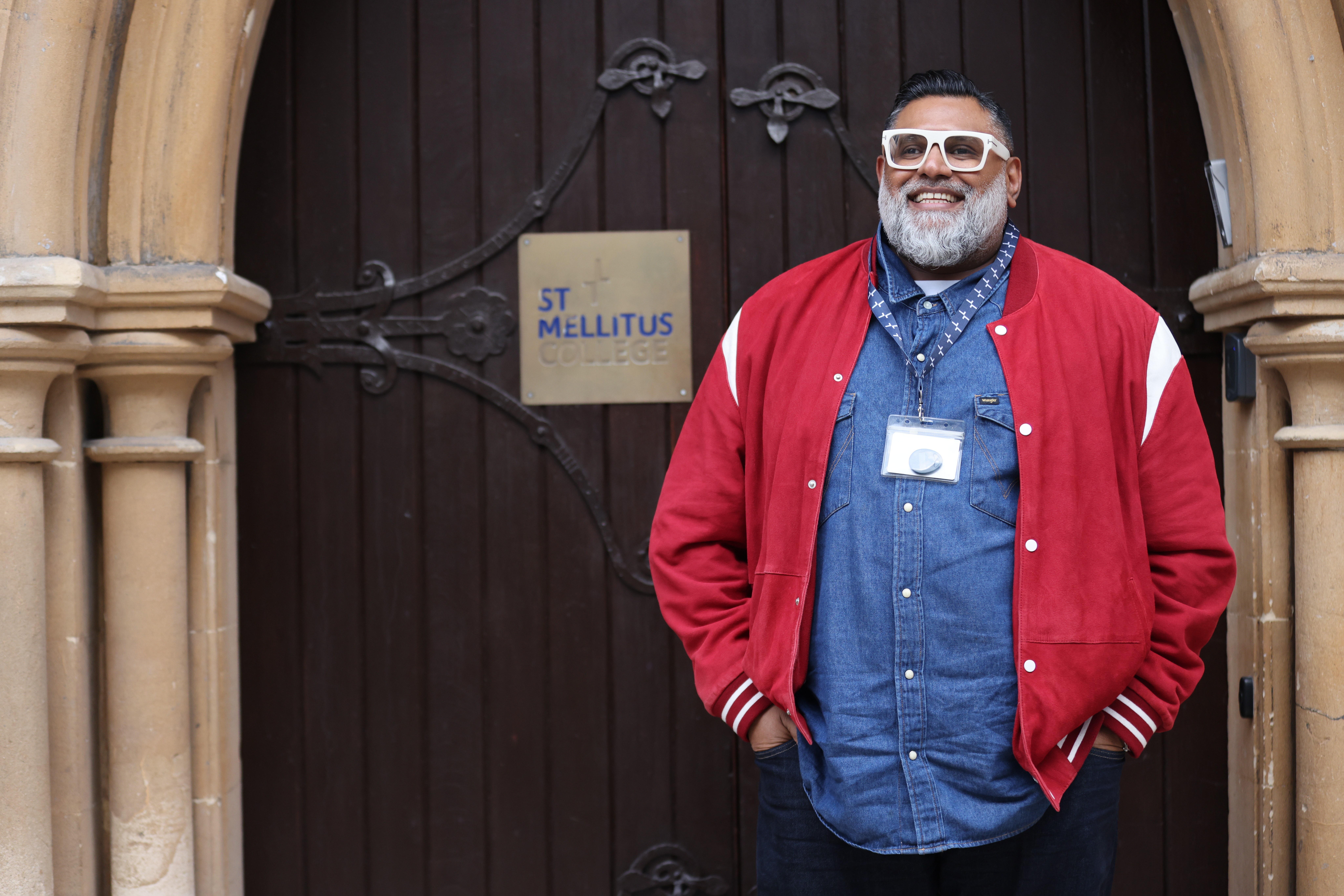
I am currently a Studio Manager in a luxury watch boutique, having spent over 20 years in secular employment, including 16 years in retail management. I began my career as a tailor before moving into the world of horology, where I now sell luxury timepieces. Looking back, I can see how it has all unfolded in God’s timing no pun intended.
I come from a Pakistani Christian family with a strong Anglican heritage. My grandfather was an Anglican priest in Peshawar, my uncle served as Bishop of Pakistan and Bishop of Peshawar, and my father was a vicar in the Church of England. Growing up, my Dadi (Grandma) would often tell me, “You need to be a priest, it’s your calling and legacy. You come from a line of priests.” I would always respond with, “No, I want to be a millionaire! And if I’m ever going to be a priest, God would really have to speak to me, mountains would have to move.”
Twenty years later, I heard that call.
2. What first drew you to study at St Mellitus College?
If I’m honest, the discernment process was challenging at times. I often wrestled with the feedback that I wasn’t “Anglican enough,” and by the time I arrived at St Mellitus, the journey had taken seven years. It had been a long and demanding road, and there were moments when I felt the personal impact of the process was not always fully understood.
A friend of mine, Joseph Diwakar, who was lecturing at St Mellitus at the time, kept speaking highly of SMC. He was a true advocate for the college, and he also saw my calling to ordained ministry. Eventually, Joseph put me in touch with a tutor who led the Peter Stream. I remember saying to him, “I’m not sure I even want to do this anymore. The process has been long and exhausting, so thank you but no thank you.” But eventually, somewhat reluctantly, I came along to an open day.
I went into my interview still carrying that frustration, but I ended up having a great conversation with the interviewer. At one point he asked, “What book are you currently reading?” I replied, “Oh, it’s something Anglican by a guy called Marcus Throup.” He paused and said, “That’s me.” “Well, in that case,” I asked, “can you sign my book?” Marcus ended up being my Formation Group Tutor.
Later, during worship, I spoke with a final-year student who listened to my story, prayed for me, and gave me the biggest hug. Then the reading was from that passage in Matthew 9, “The harvest is plentiful, but the workers are few.” In that moment, it felt as though God was speaking directly to me.
My guard came down. It was as if God was saying, “You’ve found your college and let’s start the road to your calling”.
3. Can you share a moment or experience at St Mellitus that has been particularly meaningful or transformative for you?
There have been so many significant moments at St Mellitus – the generous orthodoxy, the support of my formation group and tutor, the wisdom and encouragement of lecturers, the prayers spoken over us, and the privilege of being empowered to lead services. All of these have shaped me deeply. But one moment stands out above the rest.
During a worship night at one of the residential weeks, I felt a strong prompting that we should be praying specifically for those ordinands preparing to enter curacy. Many of us were facing spiritual battles and personal challenges, and I sensed a real urgency to pray for protection over them and their families. We were standing in a circle, praying outward. I was then asked to pray the final prayer for the ordinands.
As I began to pray, I felt an unexpected sense of strength and protection, almost as if I was being upheld while I prayed. Later, someone told me that, while I was praying, the group had stretched out their arms toward me, praying over me and covering both me and my prayers in protection. When I heard that, something shifted in me.
I realised this was not just a college, but a community: a community that stands for one another, that longs to see God move, that desires the Gospel to be proclaimed, and that is willing to break down barriers in order to do so.
It was a profound reminder that we are never called to ministry alone.
4. Theology at St Mellitus is academically demanding. Can you share a moment when you were stretched intellectually—and how that challenge shaped you?
Not being an academic in the traditional sense, I have often found the course overwhelming and demanding. It’s easy to compare yourself to others, something I have done far too many times, and that comparison is rarely helpful. There are moments when someone asks a deeply intellectual question and I find myself thinking, “I need a dictionary just to understand what’s being asked.” In those moments, it’s easy to feel inferior.
But I have learnt to pray before every essay. I ask lecturers questions when I don’t understand something. And I remind myself that it is with God’s help that I get through. Of course, there is still the reading, the research, and the hard work, but often, as I write, something begins to click. It’s as if the penny drops, and I find myself understanding more than I expected. At times, I’ve even surprised myself.
My biggest challenge, however, was the interfaith module. Coming from a country where Christians are persecuted and are often treated as third-class citizens, I struggled deeply with the way the Church of England engages positively with Islam. I found myself asking, “Why do we seem to lift up Islam when, in many contexts, Islam brings Christianity down?” The discussions were not always easy, but they helped me to listen and to understand different perspectives. They helped me see the importance of bridge-building, even where there is pain or tension. And I was reminded of Jesus’ command to “love your neighbour as yourself.”
That shift did not erase my experiences, but it deepened my understanding of what faithful, Christlike engagement can look like.
5. Can you tell us about the formation side of studying at St Mellitus College?
Formation at St Mellitus College feels distinctive because it refuses to separate theology from discipleship, or study from worship. It isn’t simply about gaining knowledge; it’s about being shaped spiritually, pastorally, and personally in the way of Jesus. What feels unique is the integration. The “generous orthodoxy” of the college means you are exposed to different traditions within Anglicanism, yet you are held together in prayer and shared mission.
Academic study sits alongside formation groups, spiritual direction, corporate worship, and residential weekends and weeks. You are known by name. You are prayed for. You are challenged and encouraged. Formation here feels communal rather than individualistic.
For me personally, that shaping has happened in several ways. Academically, I have had to grow in confidence. As I mentioned before, not coming from a traditional academic background, I often felt stretched beyond my comfort zone. Yet learning to pray before essays, to ask questions, and to persevere has formed humility and dependence on God.
Spiritually, worship and prayer have been central. Moments like praying over fellow ordinands and being prayed for. Formation is not about standing alone, but about being upheld in community. That experience marked me deeply. It showed me what it means to belong to a body that longs to see God move and the Gospel proclaimed. Communally, I’ve been shaped through honest conversations, especially in areas that have challenged me.
Overall, formation at St Mellitus has felt holistic. Head, heart, and hands are all engaged. I have been shaped not just to think theologically, but to pray more deeply, to listen more carefully, to depend more fully on God, and to stand alongside others in ministry. It has been less about becoming impressive, and more about becoming faithful: learning, slowly, the way of Jesus in community.
6. Why does theological study matter beyond the walls of a college or church—and how has your time here shaped the way you engage the world?
Anybody can stand up and preach. Anybody can lead a service. Anybody can sing songs in worship. But theological study truly matters because it takes you deeper into the life of God. When you preach, theology helps you understand what the writer of Scripture is actually saying: the historical context, the cultural setting, the theological intent. It moves preaching beyond opinion or inspiration into faithful interpretation. When you lead worship, theology helps you understand not just what you are doing, but why you are doing it.
Studying theology shapes you. It broadens your perspective, sharpens your thinking, and strengthens your convictions. It teaches you to listen carefully to those who hold different views, not so that you are easily swayed, but so that you can understand, engage, and respond with clarity and grace. Ultimately, to grow in your vocation is to remain a lifelong student of theology. Formation does not end at ordination; it deepens. To serve God faithfully is to keep learning, keep reflecting, and keep seeking to know Him more fully.
7. What tips or advice would you give to someone thinking of studying theology or joining St Mellitus College? If you could sit down over coffee with someone considering this path, what story or piece of wisdom from your own experience would you share to help guide them?
First and foremost, if God has called you, then give it everything you have. Be open to being shaped in theology, in worship, and in the richness of Anglican tradition. Allow your heart, soul, and mind to grow in love for Scripture. Be prepared to go deeper with God and deeper in your understanding of the Gospel. Learn from others. Be courageous enough to step outside your comfort zone.
If you come from a low evangelical charismatic background, attend a high Anglo-Catholic service. If you are more liturgical, spend time in a different expression of worship. Don’t put Jesus in a box. Remember, God is at work across the breadth of traditions.
Above all, never stop praying. “Pray without ceasing.” Stay rooted in conversation with God, especially when the journey feels stretching or uncertain. And always remember you have been called. “The harvest is plentiful, but the workers are few.” Hold onto that calling with humility and faithfulness.
And remember your support network: your wife or your husband and your kids. Remember to show love and gratitude, as they have sacrificed a lot more.
Lastly look after yourself, be accountable, and make friends.
8. In three words, describe your time at St Mellitus College. Why those words?
Love – Love for Jesus. Love for Scripture. Love for people. A love that reflects grace, patience, and compassion. A love that is rooted in prayer and expressed in action.
Deeper – Allow theology to take you deeper into the understanding of who God is. Let study shape not just your thinking, but you’re praying. Go beyond the surface so that your faith is formed both intellectually and spiritually.
Truth – Your calling is about making the kingdom of heaven known on earth. It is about sharing the love of God without prejudice and proclaiming the gospel so that others may come to know Jesus and understand how deeply God loves the world:
“For God so loved the world that he gave his one and only Son, that whoever believes in him shall not perish but have eternal life.” (John 3:16)
Love, depth, and truth, held together, shape faithful ministry.