
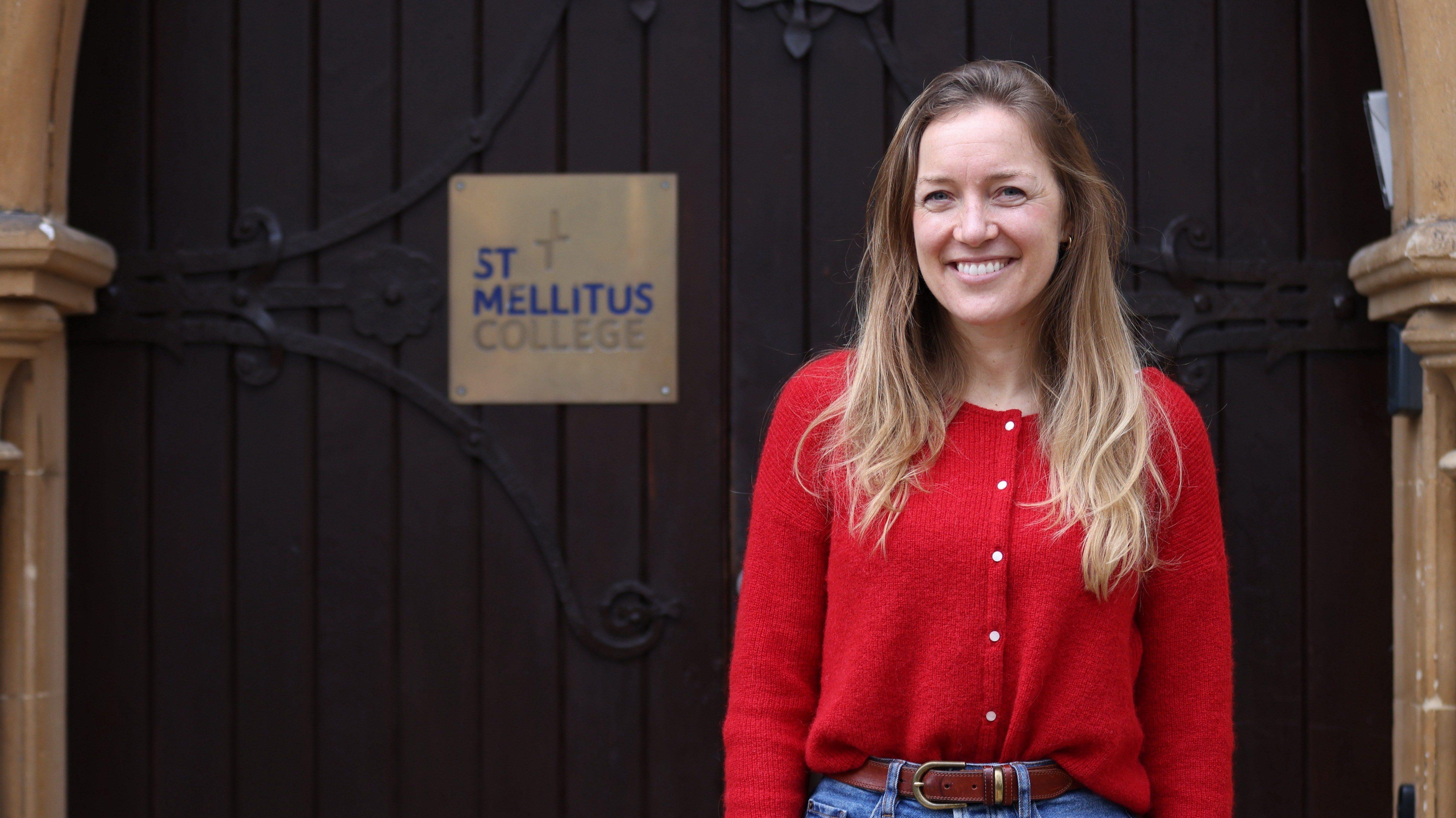
Dr Anna Westin is a Tutor and Lecturer in Theology and Ethics at our East Midlands centre.
What’s the story that led you to St Mellitus College?
Since a kid, I have had a sense of the friendship of Jesus. We moved a lot when I was little, so I became quite used to being different, but had this kind of naive trust in God's presence with us, and that it contained power. Throughout teens, this reality of God was challenged by what I saw as the hypocrisy of the institution, its people. There was a lot of pain in the contexts we were in. But Jesus continued to show himself to be the one 'good thing', and throughout I have felt that line of Peter's resonant: 'Rabbi, where else would I go? You are the Life.' Humanity is complex; I can be complex.
St Mellitus has enabled a deepening of discernment in this Way of Life, the sense of the Holy enshrined as a way of being in the world. Sometimes it is very mundane, like getting marking done. Sometimes it is the opening of revelation through reading a new word. I am grateful to have learned and been shaped from the Spirit's work in this place, particularly through my East Midlands team.
Why does theology — and formation — matter to you today?
I think it is existence itself. The movement with God is the beginning and the end; everything coheres in God. The more I think of what John 1 means, of the Messiah as life and light to all being, it reverberates through everything. That God is also Love that casts out fear. I remember Nouwen writing: Are you dwelling in the House of Love? I keep thinking, what does this mean in this situation, for me, for this place, right now? It is so unlike what else is on offer, so much more robust and beautiful. And yet, it loves society - is taken up in the mundane, at the place of eating and drinking, as Ellul says.
What makes St Mellitus College distinctive in your eyes?
I think it is the joy and the humility, the dependence on the Spirit's presence. We are not so strong really, in the world's eyes, right? We need to rely on God's strength. The students are each choosing to surrender their lives to God. This is quite a radical act, when I think about it. And that makes it a very exciting and authentic place of encounter and creativity.
How do you hope your work shapes students and the wider Church?
I am unsure. I hope that students will know that they are loved, that they are significant in the eyes of God, even as they lay their lives down for others. That they are not afraid of the big questions, or the world's undoing and hardness. That God will be faithful. That they can be wise and innocent; strong and gentle, because they are in friendship with Jesus.
What’s one truth you’ve learned through challenge or change that shapes how you serve today
I think it is that we may at times feel God asking us for everything. But God also gives us back the 'more than', because our measurement systems are not intricate like God's are. God is 'au-delà de tout (underriding it all). I have tried to attend to the holy silence this year, in listening to others, in contesting for lives in prison, in places of isolation, and pain. Taking communion has felt like a holy task this year, and having grace for myself and others, which comes with just showing up and trusting the patient work of God. And, God keeps showing up for me too, keeps proving faithfulness, and keeps undoing the patterns of wounding I had predicted to be necessary for the human condition, even when it is hard.
Are there particular women — mentors, colleagues, or theologians from history — whose work or witness has shaped your theological imagination? How has their influence shaped your own teaching and scholarship?
It has been a season of gathering wisdom from lived female presence. A woman that I have been learning from recently is Mary. I have often bypassed her before, but the line of harbouring the things of God in her heart has been something I have been mulling over myself. That everything does not need to be spoken to become real. That El Roi, the God who Sees, sees what we see, and helps to collect it into our heart and hold it with what has been spoken before, in the mystery that brings revelation. I think that's a form of mystical hermeneutics.


