
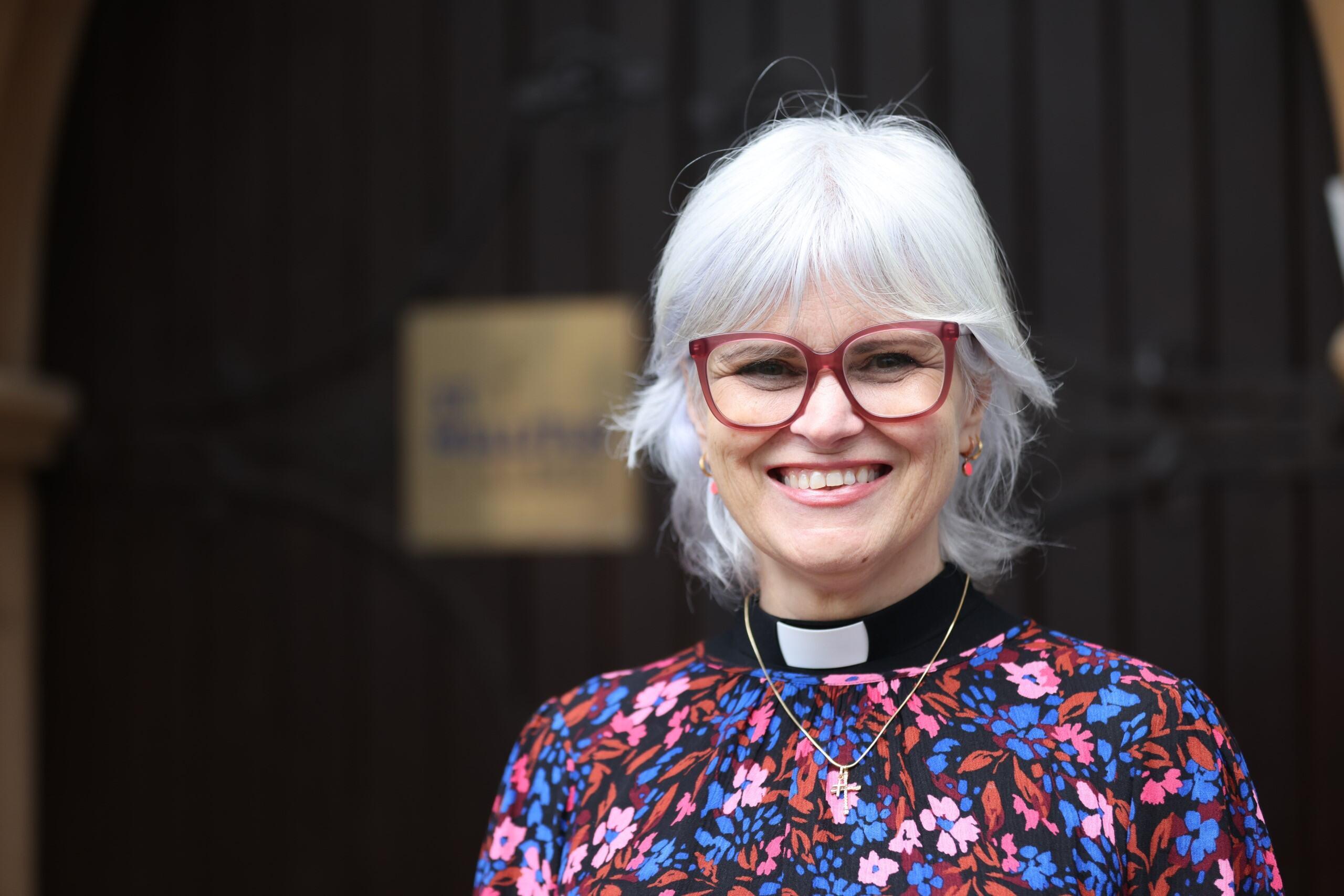
When did you study at St Mellitus College? What program were you in?
I studied for ordination part-time on Tuesday evenings in London, but I actually began with the Peter Stream programme. It was amazing, really, because it was during the pandemic. We had just joined a new church as a family with four children, and we hadn’t been there very long before we went into lockdown.
During lockdown, there was a WhatsApp group for the women at church. People would send through prayer requests, and others would gently support and encourage by replying with praying emojis. But I remember very clearly that God said to me, Look, you’re here, it’s lockdown, and you’re not super busy. You’re not working, so send them your actual prayers. So I started responding with the real prayers I was praying for those women.
It was during that time that my vicar approached me and said, “Have you ever thought about ordination training?” I said, “No.” Then I added, “I couldn’t do that anyway, I’m a woman!” We laughed about it. I think that came from my Roman Catholic upbringing; I loved women leading church but it wasn’t something I was used to seeing. I also wasn’t educated -- I’d never finished secondary school. So I said, “Even if I wanted to, even if that’s what God was calling me to, I couldn’t do it because I don’t have any further education. It’s just not possible.” And he said, “Well, you should think about it.” Then, during Focus, it was online that year, I had this growing sense that God was calling me to do something in the church, which I found quite hilarious given my background. I grew up in the Roman Catholic Church in Australia; my parents are Italian.
As a teenager and young adult, I drifted away from church completely. I didn’t really have a personal relationship with God. If something wasn’t going right in my life, I’d call my mum, who’s a strong woman of faith, and ask her to pray because I thought she had a “direct line” to God. But I came to experience the power of the Holy Spirit for myself through an Alpha course when I was in my thirties, here in the UK, and that’s how I came back to church. At the time, we had young children, so my experience of church community was as a tired mum -- rock up on a Sunday, hand my children over to the youth team, have a break, fill my cup, collect them, and go home again. So, I thought it was hilarious that God might be calling me to do something more. I honestly thought the deal was that I’d turn up on Sundays, hand over the kids, and just try my best for the rest of the week! But there was this increasing feeling of being called to lead women in the church, which I had no experience of.
When Nicky Gumbel came on during that online Focus and said, If you feel God is calling you to something, reach out and have a conversation with someone, I decided to meet with my vicar again. Actually, he called me in, it wasn’t me seeking him out. He said, “I just wondered if you’ve thought any more about it, because we’ve been praying, and we think we’ve got a word for you.” I told him it was strange, but I felt God might be calling me to do something with women. And he said, “That’s exactly what we sensed too.” So I began gently building a small community of women who would gather to pray and worship together. It was really lovely. Not long after that, my vicar came back again and said, “Look, we really think you’re being called to something more. We’d love for you to pray about it. There’s a pathway we think might be right for you, it’s called the Peter Stream.” When he explained what the Peter Stream was, I thought, Maybe it’s not just me. Maybe God really is calling me to ordination training. That’s how I ended up at St Mellitus.
I remember starting on a Monday, but the day before, my husband and I came into town so I could see where it was. I stood outside St Mellitus and prayed, Lord, am I really meant to be here? I don’t think I can do this. I didn’t finish school. I was too scared to take exams—and I’m not sure I can do this. And I felt God say, My strength will come through your weakness. So I said, Alright, Lord. If you need me to be weak, I’m feeling very weak right now, but if that’s your promise, then I’ll just take it one day at a time. I’ve always been quite an obedient girl, so that’s what I did. I remember walking through the doors that Monday morning and immediately feeling a sense of belonging—like the moment I stepped in, I knew: This feels like home. This is where God wants me to be. And that’s how I ended up at St Mellitus. Yeah—that’s the long story.
What do you do now, vocationally?
When I came through the Peter Stream, I just assumed I’d be studying full time and going into full-time church ministry — that’s what I thought ministry looked like. After Peter Stream, though, I was told I’d be studying part time. At first, I thought, maybe I’m not good enough for full time. The full-timers were there for two years, the part-timers for three, so I figured it must be because I wasn’t clever enough. Still, I was determined to come, because I loved the college, it felt like home, even if I wasn’t sure what God was doing.
It was only through the training itself that I began to see God gently building a picture of what my pathway would look like. I came to realise that I was meant to do part-time training, and that was important. What I haven’t mentioned is that, when I first felt called to explore ordination, it was during the pandemic, but it was also the height of our eldest son’s drug addiction. There was a lot of turmoil at home. I remember one of the first lectures where the speaker talked about how God interrupts people’s lives and calls them in the midst of it all, and that really hit home for me.
Part-time training turned out to be such a gift. We went through many ups and downs, but the support was incredible, and the pace gave me time to breathe. Honestly, I loved the college so much I could have stayed another ten years, so I don’t know why I was ever in such a hurry! Another surprise was hearing the diocese talk with me about self-supporting ministry. I wasn’t sure what that meant for me. Part of me still thought, maybe I’m not good enough for full-time ministry, and part of me wondered, Is this something I’m meant to challenge? But towards the end of my second year, I felt more and more certain that God was calling me to be a self-supporting minister. I’d always imagined ordained ministry meant working in a church full time, but I love people, especially those who don’t yet know Jesus. I’m a bit of an evangelist at heart; I love those everyday conversations and connections. During my second year, I started getting itchy feet and prayed, Lord, I want to be in my local community somehow, but studying is hard for me. Could there be something that lets me do both?
Two weeks later, walking to the shops, I saw an advert in the pharmacy for a part-time position. I popped in, they already knew me, and when I said I was enquiring for myself, they said, “Well, you’ve got the job.” Just like that! I told them I was training, and they were happy to accommodate my schedule. Working there alongside my training made me realise this is what self-supporting ministry looks like for me. I’ve always said I have one foot inside the church and one foot outside, and through that season God helped me see how it all fits together. Now, I absolutely love being a self-supporting minister. I work three days a week at the pharmacy, and I see that as part of my ministry. I pray for people, talk about Jesus, invite them to church. Then on Sundays and Tuesdays, I’m at church — leading, planning, organising, and doing meetings like PCC in the evenings.
Through my time at St Mellitus, I also discovered I have ADHD, which probably explains why I’m so chatty! But it also means I thrive on variety. I love the mix of ministry and secular work; it keeps me energised and connected. The church is just ten minutes from home, the pharmacy fifteen, and I often see church members picking up their prescriptions. It’s lovely, I get to pray for them, point people towards church, and just be present in the community. That’s what ministry looks like for me, and I absolutely love it. It’s a real joy.
Reflecting on your time at St Mellitus, what resonates most with you?
Probably the thing that's mostly my love language, which is the diversity. I absolutely love the diversity of the college, first with Peter Stream and then with Ordination training. Culturally, there’s so much richness. I was born in Australia, my parents are Italian, and my mum was born in Egypt, so already there’s a beautiful mix there. I’m also married to a British-born Sri Lankan, and we have four children, so there’s a lot of cultural richness in our family.
That’s one of the things I love most about St Mellitus, it’s so wonderfully diverse, and to me, it feels reflective of Heaven. But it’s not just cultural diversity; it’s also generational. I’m 54 and I love that at St Mellitus you’ve got young people, middle-aged people, and older people all learning and worshipping together. That mix is one of the very best things about the college. And it’s not even just that, there’s diversity in faith backgrounds and church traditions too. I think diversity is one of the most beautiful things God ever created: that we can all be so different, and yet so united. St Mellitus does that so well because of its ethos of ‘generous orthodoxy’. Whenever anyone asks me what my favourite thing about St Mellitus is, I always say generous orthodoxy because it captures everything I love about its diversity.
If I could add one more thing, it would be the incredible quality of teaching and the lecturers and guest speakers we were privileged to learn from. They’re not only gifted in their craft but also encourage real critical thought and open debate, not just among students, but with them. That, to me, is the mark of a great teacher. I have so much respect for their academic and theological skill, but also for their pastoral hearts.
Why would you encourage someone to study theology?
Yeah, well, first I want to say, I think everyone should study theology, whether they feel called to ministry or not. Because it’s not just about theology itself; it’s about learning alongside others who each bring something unique to the table. The conversations, the different perspectives, it’s wonderful. It’s honestly impossible to leave a class or a discussion without thinking about what you’ve just learned, reflecting on it, and somehow letting it shape your day-to-day life.
I really believe the world would be a better place if everyone studied theology because whether or not we’re called to ordained ministry, we’re all called to something. If I’m honest, before I ever felt called to ministry, if I’d known this kind of learning was available, I would have signed up straight away. For anyone who’s even a little curious — or who has that deeper desire to explore faith and life — it’s such a gift. You can’t study theology and not be impacted by it. And that impact naturally flows out, changing the way you live and influencing the people around you. And again, going back to diversity, I love that people study theology for all kinds of reasons, not just calling. Because outside the college, we all live together in the same world, and it’s so valuable to hear different perspectives and experiences. Everyone brings something of worth. You might agree, you might disagree, and that’s okay, but either way, studying theology changes you. I think it’s just impossible to walk away and not be impacted.
Can you share a story about how you have seen God moving in your life since leaving St Mellitus?
Well, God is definitely on the move. And I think when you’re in this kind of environment, you become more aware, more alert to God’s movement in your life. There are so many areas where I’ve seen that. With our eldest son and the challenges we’ve faced with his addiction — he’s doing so well now, he’s a recovering addict, four years clean. I remember leaning so heavily on my formation tutor and my peers for prayer and support, both spiritually and through friendship. To think that those people, through this environment, were standing with me and lifting him up during that time is so beautiful. I still cry when I think about it.
And for me personally, I’ve never been shy, I’ve always been good at chatting to people, but I never really had a sense of worth. For lots of reasons: upbringing, life experiences, and especially the academic side of things. I just never thought of myself as an academic. But going through this process has grown my confidence twofold. I actually like who I am now. I see myself as capable because I’ve seen how faithfully God has carried me through. He kept that promise He made to me when I prayed outside the college on that very first day. I’m just a different person. It’s hard to explain exactly how, but I think the most wonderful thing is the awareness that this is an ongoing formational journey.
Even though I’ve finished college, I still find myself drawing on what I learned at St Mellitus all the time in my work at the pharmacy, in church, and in my family life with my husband and children. I’ve made such beautiful friendships here. We still keep in touch even though we live far apart and we’ve already met up a few times. There’s this sense of family that extends beyond the college walls. I hope there’s a richness in my character now — it certainly feels like it. It was hard work, but that’s okay; hard work never hurt anyone. God journeyed with me every step of the way, and I’m richer for it. I feel hugely blessed. I don’t think a day goes by now without me connecting something in my life to what I experienced or learned at college. There was so much joy and beauty in every part of it, even in the hard parts. Not a day goes by that I don’t feel deeply grateful and blessed by that experience.


