
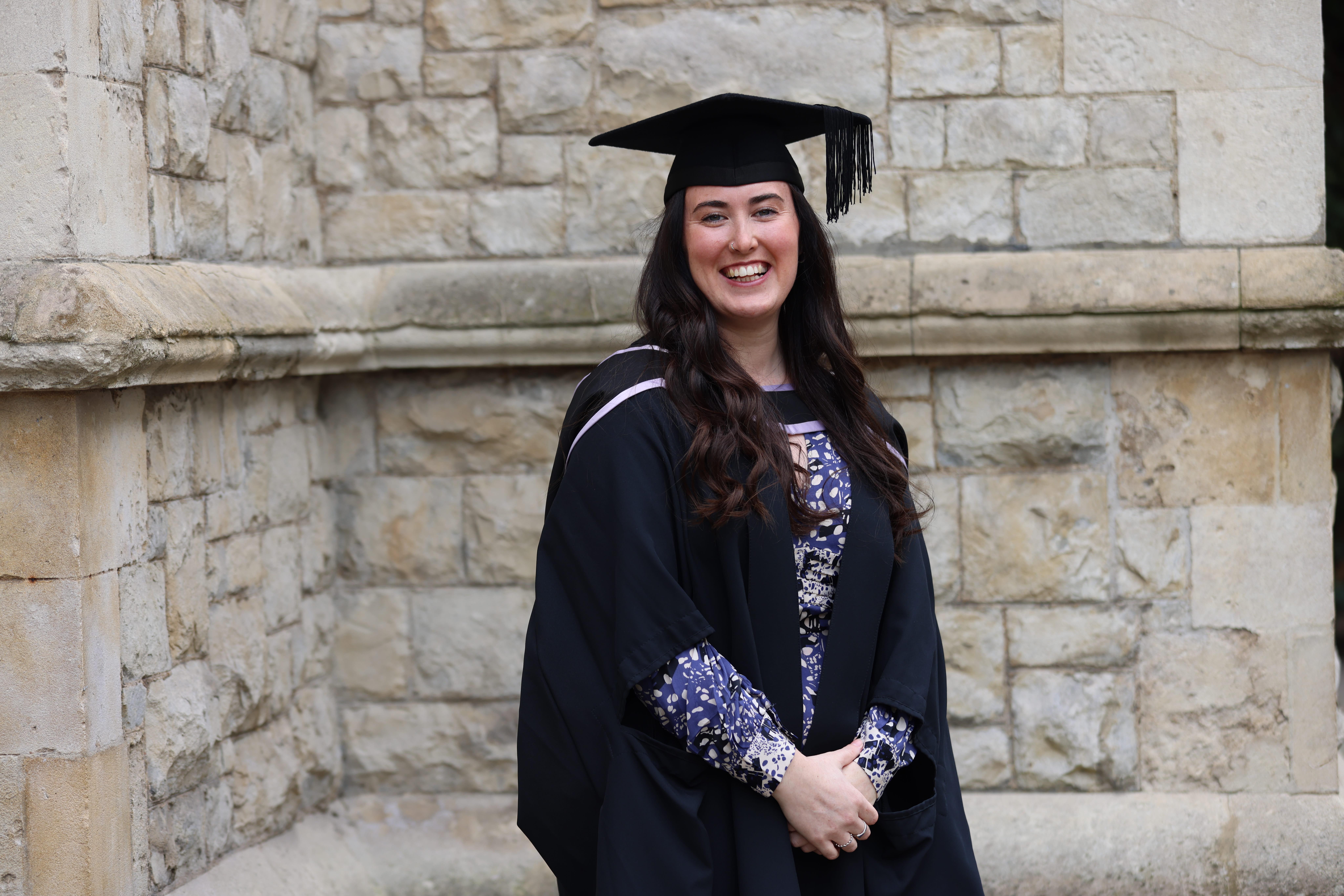
When did you study here?
I started at St Mellitus in 2019 as an independent student in the Theology and Youth Ministry programme. Then it was the first year of COVID, so I had my first six months or so and then we went on our March retreat. At that retreat, they said, “We’re going online for a while,” and we didn’t know when we’d be coming back. I did a year and a half in COVID finishing my undergrad degree, and then in 2023, I stayed at St Mellitus and started my Master's. I did a Master's degree in Mission and Contemporary Culture, and I loved it.
What stands out the most about your experience studying here?
One of the things that really stands out is the people. I met some incredible people. I think of the library a lot — I was a very regular attendee at the St Mellitus Library. Our retreat times were really significant for me as well. Also, being able to sit in lectures and have lightbulb moments, and have discussions with people from all different walks of life, with so many different stories that they were bringing to their study of theology. And I was one of those weird people who loved writing essays. I can honestly say the whole time, even the stressful moments, was such a joy.
Formation is a key part of studying at St Mellitus. In what ways do you see how you formed or shaped during your time here spiritually, academically, personally, your spiritual formation? How has that continued to influence your life and faith?
So I started here when I was 19, and now I’m 26. I feel like some of my key formative years have been here. Being able to have that one thing — those Mondays that stayed the same — was so significant. This year is the first year I’ve ever worked on a Monday, but for me, those Mondays were such an amazing time. I knew that was my routine: arriving at St Mellitus, having my cup of tea, and going to worship and then teaching. Even though so many other things changed around it — my job, where I lived, my church, those kinds of things — for five years, my Mondays stayed the same.
I think it was so significant for me to have that. As my faith evolved, and as I learned specifically what it meant to lead worship, it was so amazing to be able to study who God was and, therefore, who I am alongside that.
How did your character form and shape over that period?
I think I’ve probably become a bit more confident, and I think I’ve also realised that I love the simpler life. I probably started my studies with a crazy schedule and, for the first few months, wouldn’t have had a moment of free time, and I would’ve loved every moment of that. But if I look at my life now, I love a slow morning, having free, simple evenings, and being able to just go slower.
So I think, in terms of my character, I’ve learnt to go slower and just sit and be. I’ve learnt how much richness there is around me in people, and to make the most of it — to take every part that I can. I think my time at St Mellitus really taught me how much God can teach me through someone else’s story, and being in a place like this, where everyone is here, everyone is represented, and you get that in all its fullness.
What does your day-to-day life look like now?
At the moment, I’m a teacher. I work in a local high school and I teach PE. So I guess it is slightly different from my studies. My day-to-day life often looks like standing in the rain and having really soggy socks. I work with young people and I have a sixth-form tutor group.
How has theology shaped how you lead and serve, both as a teacher and also in your church context and in your community?
I think studying theology can go hand in hand with anything that you’re doing, because God is a God of all things. It means that you can relate His character to anything that you’re doing. When I’m teaching students about our physical bodies, and the importance of our physical well-being and moving our bodies, that so relates to us as created humans – having a body that we are called to honour as temples of Him.
I think, for my context, it looks slightly like that: what does it mean for me to have this body that God has given me? Also, I work in a Church of England school, which means I’m able to attend communions with my students, and we sing in assembly. So many things that we learn about within theology – why we are created to sing and worship – translate so well into things that all of us do day to day.
In what way have you seen God at work in your life in your context? Is there a particular memory or moment that you would like to share?
I am very fortunate to work in a school where we have students who want to chase after God, who are fully in love with Jesus, and who want people to know about it. We have a worship night called Ignite that is open to students, parents, teachers, and any students’ friends who want to come along.
We had one recently where we had a guest speaker who was meant to come but had to pull out at the last minute. One of my colleagues messaged me and said, “Okay, I’m going to give the talk,” but he doesn’t love preaching in school because he doesn’t want people to just see him as the guy who tells them their skirts are too short or asks them where their tie is. He doesn’t want that to be a barrier. So we were just praying about it the next day, and as we were praying, I had a picture of a sixth-form student, who I didn’t really know very well, giving a word to the room. So I said, “I’m praying for you, but also I believe this student could have a word for the room.”
And the next day, this same student went up to the teacher and said, “I really feel I have a word for the room tonight.” He said, “No way! Have you been speaking to Miss…?” and he said no.
Then he came up to me and said, “Miss, I feel like the Lord has put this on my heart. I have this really clear picture and a scripture from Ezekiel.” And I said, “Amazing! C’mon!” I showed him the messages that I’d sent with the other member of staff, and his mind was blown. He was walking around with his Bible, so ready to go and so on fire.
I remember, in a previous interview that I did while I was studying, talking about how my study of theology equips me to always be able to answer, “Why do you follow Jesus?” – to be able to preach the Gospel at any moment. And I think I just saw that in him. At that moment, I thought, “Wow, you are so ready to preach the Gospel. Anyone who asks you right now, you’re fired up and ready to go.”
So the night arrived, and he got up to the front, kind of nervous, and he just opened his mouth and said, “Revival is coming to school.” And everyone just lost it. It was incredible. He spoke with such authority, and we had an amazing ministry time, being able to pray over staff and students and parents at the end.
For some of those who have gone to a Church of England school and heard all the Bible stories and attended communions, but never really had it click for them that this story is for me – this is how I can inherit eternal life, this is Jesus speaking directly to me – it was so incredible. It was an incredible story of me being able to be in that school alongside my studies and youth ministry, and then being able to see such fruit over time.
What would you say to someone who's considering studying theology?
I think my studies and the culture at St Mellitus taught me that it’s a part of how we’ve been created. It’s almost a call for us, as people who follow Jesus, to study theology. And I don’t mean to say that every Christian has to do a degree in theology. But I do think we have a duty to study this God that we worship, to study the scriptures, and to be in conversations where we’re unpacking topics about His character and scriptures that we aren’t certain about.
The way I have been formed to study theology at St Mellitus is with the sense that I’ve been called to do this because this is how I honour God with my mind, this is how I love God with my mind, and this is how I continue to form my faith and my relationship with Him so that I can translate it to others.
I think it’s something that we’re all called to do. Therefore, if the opportunity arises, and you have the capacity or an opportunity to study theology – whatever that looks like, maybe a degree, maybe Beginning Theology, maybe just watching a YouTube video or creating discussion groups with your community – I think it’s something that we’re all called to do.
And it’s something that, when done in worship, teaches you more about who God is, allows you to love Him more, to love yourself better, and then also allows you to discover who you are, what you’re created for, and therefore be able to love the people around you better.
You were in the Youth ministry programme, and now we have something called Future Generations training, which is very similar to what you did, equipping those who are working in youth and children’s ministry. We have some bursaries available to cover part of the tuition cost. Coming from someone who works with youth, what would you say to someone working in education, or youth work at their church, volunteering for children’s or youth ministry? How could it help them support the young people that they’re leading?
I think that if you are in any of those areas – if you’re teaching, if you’re serving in your church’s children’s ministry or youth group, and you feel that this is something you know you’re called to do – studying theology alongside it is just such an essential tool to have under your belt.
Young people and kids have so many questions, and their minds and imaginations are incredible. Being equipped to help respond to those questions, to facilitate discussions for them, to explore those questions, and to have a greater awareness of the Bible, church history, and all of those kinds of things – I would say it will honestly make your calling come alive as well.
Everything that you study, you’ll be able to relate to what you’re doing, and it will make what you’re doing feel so significant. As you study, you’ll be able to see why what you’re doing is so important as well.


